
It's me, Oh Lord, Standing with a Gun
- Aya
- Sep 13, 2020
- 3 min read
Updated: Sep 21, 2020
Presented by Radin Nasuhakamar binti Radin Shamsulkamar

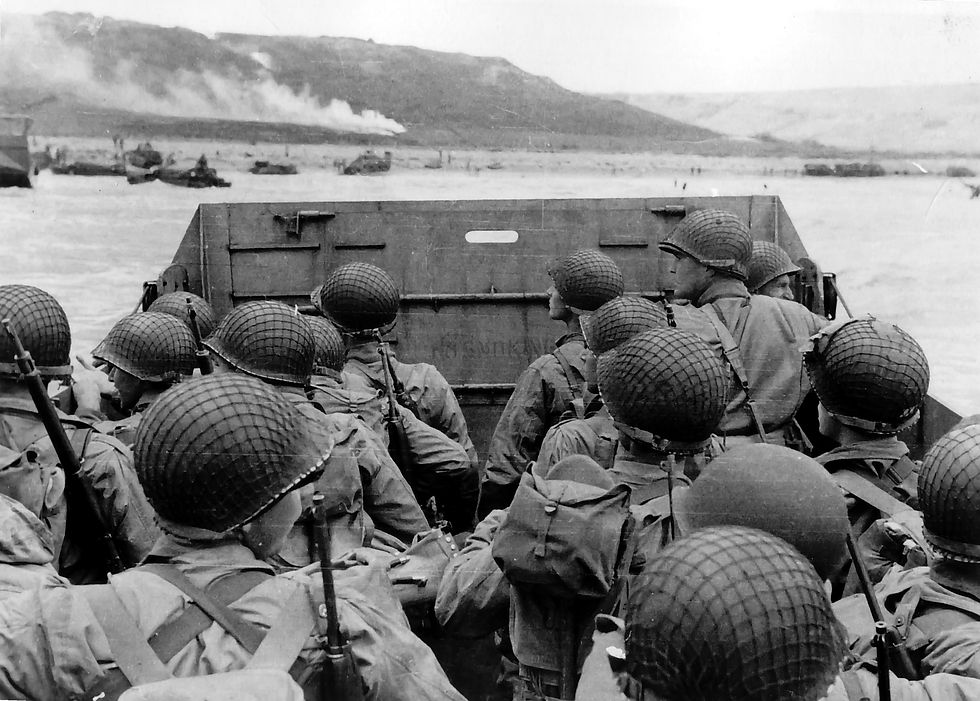
D-day, Normandy Landings, Omaha Beach, (1940s).
This poem tells us of what happened on the battlefield back in World war II as the poet, Hubert Creekmore himself was part of the U.S Navy before turning to literature after his retirement. Creekmore has five other poems and has translated four of Stephane Mallarme.
Poem
It's Me, Oh Lord, Standing With a Gun
They crouch in the barge
and the palms roll close,
Green echo, high over sand, of waves,
Of gray jelly-fish in smoke puffs whose
Invisible sting is swift and leaden.
They crouch, tongue dry, in the boat,
And all the world is a puny beach-head :
World of clean-sliced hemispheres
Of latitudes of love and crime,
Peopled with the mental smears
Of medieval magic, thinning
To a short horizon
Under war's tremendous engine
Through which the war
blood streams, and great
Einsteinian logistics, drown
Upon this coast of conquest.
Here is All of war, compact.
It is simple.
It is death-fear.
Undiscriminating death
Appraises his approaching guests,
Uniform in gear, beneath which shiver bodies,
black and white skinned, but uniform in value
As currency of life,
Their insight
Penetrates the island's pull,
Magnetic jointure of here-after.
Across the rail, the Negro full
In death's face stares and blinks,
beside him,
son of owners of slaves,
Floating of a mortal hyphen,
tongue-tied.
And the hyphen joins the puzzled past:
The tired way, down which they came,
Twin exile of historic trust,
And fades in the jungle's blinding chaos.
For on that final range
Men sprawled, too patient in the wave lay
Letting the gently anxious foam
Entomb their scars in sand.
No scales
Enamel the minds of two from whom
All memory soon may flee. The Negro
And the Southern man
Reflect how inner bondage subtly
Links them to oppose what fought,
At home between them: tenant house
Of jerried boards, and
house it wrought
Of moonbeam pillars; loom of clod-veined
Overalls that wove
Traditions's silky gown. The drained blood
Mirrors doubly self and war.
Retreating in the glasses to
Extinction.
The Negro fighting for
A freedom fraud, the white for freedom
Mortgaged to mistrust,
Fight to shield the bigot's long breed.
And while the boat rolled on the waves,
Palm surf roaring at their face,
The Negro felt, not as on slaves,
The white hand on his arm, and heard him:
"We can do it, can't we"
And some familiar thing was lost words
The strakes grate on the shore, defy
Horizon turned foreground of slaughter.
Whether I, the Negro, lie here or return,
by all past tokens,
Medals are for white men,
Jim crow life for me and my folk

Upon the coral shingle they leap,
And rush the smoking jungle.
Round their legs the salt-curls break and seep,
Crumbling soon the mold of footprints,
streaks of red, shell-studded blot in sand,
in waves are washed mute.
What happened?
Around the 1940s, the Allied forces (France, England, United States, Canada, and their aids) invaded Normandy. This took place on Omaha Beach, hence the descriptions of boats, palms and sand. Although the main point of the poem is to honour and tell the story of the soldiers that participated in Operation Neptune of what happened on the day. Not only is the poet telling a story about their fallen heroes but he also mentions segregation of race and the irony of it. The obvious use of 'white and black-skinned' and 'the Negro'. The irony of fighting in a war for men who enslave others but the badges of honour are not for the ones who re of colour but only given to those who are fair-skinned. Thus, the mention of 'Jim Crow life for me and my folk'. The fallen heroes are not only those who had sacrificed their life against the Germans but also those whose names that will forever be lost due to only honouring one race.
Lessons
Race does not determine the success of a battle.


Comments